
Welcome to the Internet of Peers
The web was meant to connect people directly. Somewhere along the way, it learned to ask permission first.
Software shouldn't need permission to exist
Every app you use today is renting its right to run. It lives on someone else's servers, behind someone else's billing, subject to someone else's terms. The moment the bill goes unpaid, the company pivots, or the platform changes its mind, the software you depended on simply disappears, and takes your data with it.
That fragility isn't a bug in the cloud. It is the cloud. Centralization is the business model, and surveillance is how it pays for itself.
No servers. No gatekeepers. No off switch.
The cloud was a detour
The client-server model made sense when devices were weak and connections were scarce. So we put the real computer in a data center and handed everyone a window into it. Three decades later the window is all most people have ever known.
But the trade was steep. To use the cloud you surrender custody of your data, route every interaction through a chokepoint, and inherit a single point of failure for your privacy, your uptime, and your autonomy. Outages cascade. Keys get subpoenaed. Accounts get banned. Whole products are switched off because a roadmap moved on.
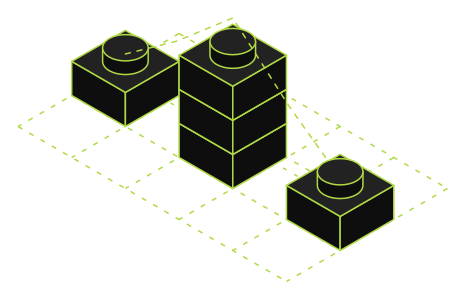
At Tether, we break conventions. We believe the software you rely on should answer to you, not to a server you will never see.
There is another way to build
Devices are no longer weak. The phone in your pocket is a supercomputer with a permanent connection. The missing piece was never compute. It was a way for those devices to find and trust each other without a middleman.
That is what Pear is.
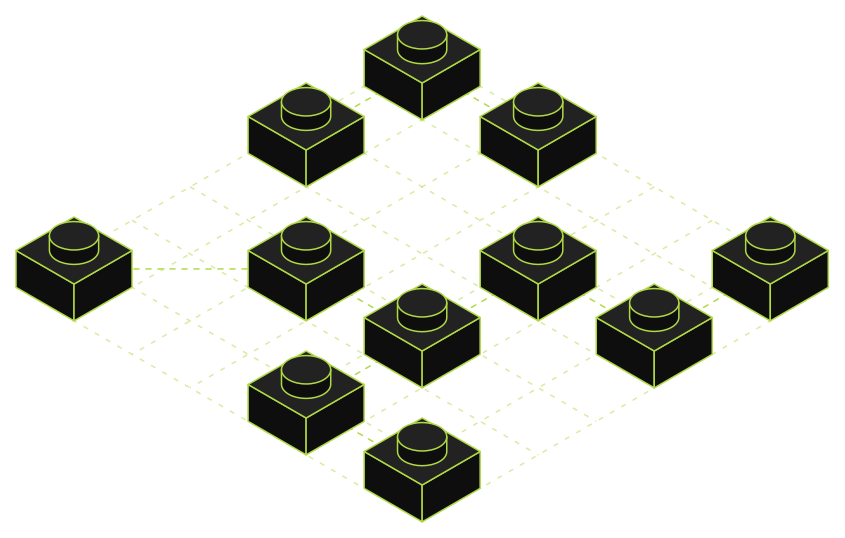
Pears is Tether’s open-source, peer-to-peer runtime. Apps talk directly, device to device, over three primitives.
- Peers. Every device is a full participant: it stores, serves, and verifies its own data with append-only Hypercore logs. There is no client and no server, only peers.
- Swarms. Peers discover each other by topic on a distributed hash table, HyperDHT, so a network forms around the data itself, with no directory to take down.
- Holepunching. Encrypted connections are negotiated straight through firewalls and NATs. No relay servers, no public IPs, no infrastructure to rent.
Write it once in JavaScript on the Bare runtime and it runs the same on desktop, mobile, and terminal. The result is software with no center, and therefore no edge to attack, no bill to outgrow, and no switch to flip.
What peers unlock
When you remove the server, you don't just cut a cost. You change what software is allowed to be.
- Sovereign. Data lives on the devices that create it. Users hold their own keys, so you never become the custodian of someone else's life.
- Resilient. No central point of failure. The network gets faster and stronger as more peers join. As long as one peer is online, the app is online.
- Private. Connections are end-to-end encrypted and metadata-free by design. There is no central database to leak, subpoena, or sell.
This is not a thought experiment. Keet moves encrypted calls and files with no servers in the middle. PearPass keeps secrets fully local. A growing community is shipping P2P tunnels, location sharing, and wallets on the same stack.
Unstoppable apps, owned by the people who run them.
We’re Tether. Unstoppable together.
Build on the Internet of Peers
One JavaScript codebase. Desktop, mobile, terminal. No servers, ever.